Understanding the CIS: A Guide for Construction Companies
Understanding the CIS: A Guide for Construction Companies
If you work in construction, whether you’re a contractor bringing in subbies or a subcontractor juggling multiple sites, you’ve almost certainly come across the Construction Industry Scheme, or CIS. And if it’s ever felt confusing, that’s totally understandable.
CIS is one of those areas where the rules are straightforward in principle but surprisingly easy to get wrong in practice. Getting it right protects your business from HMRC penalties, keeps your cash flow predictable, and means no nasty surprises at year-end.
Here’s what you need to know.
What Is CIS?
The Construction Industry Scheme is an HMRC tax scheme that governs how payments are made between contractors and subcontractors in the construction industry. Rather than subcontractors receiving their full payment and managing their own tax, contractors are required to deduct tax at source and pay it directly to HMRC on the subcontractor’s behalf.
The scheme exists because construction has historically seen high levels of tax non-compliance, largely due to the casual, project-based nature of the work and the large number of self-employed workers involved. CIS is HMRC’s way of collecting tax earlier in the process and reducing the risk of it going unpaid.
Who Does CIS Apply To?
CIS applies to contractors and subcontractors working in the UK construction industry.
You’re a contractor under CIS if:
- You pay subcontractors for construction work
- Your business spends more than £1 million per year on construction (even if your primary business isn’t construction, think large retailers or property developers)
You’re a subcontractor under CIS if:
- You’re paid by a contractor to carry out construction work
- You may also be a contractor yourself if you employ your own subbies; many businesses in construction operate as both
What counts as construction work?
CIS covers a wide range of activities, including:
- Building, demolition, and civil engineering
- Installation of systems (heating, lighting, plumbing, security)
- Painting and decorating
- Preparation work such as scaffolding and site clearance
- Repairs, alterations, and extensions
Some activities are excluded, including architecture and surveying, carpet fitting only, manufacturing or supplying materials without installation, and site security.
Registering for CIS
Contractors must register with HMRC before taking on any subcontractors. You can do this through your Government Gateway account.
Subcontractors don’t have to register, but there’s a strong financial incentive to do so. Here’s why:
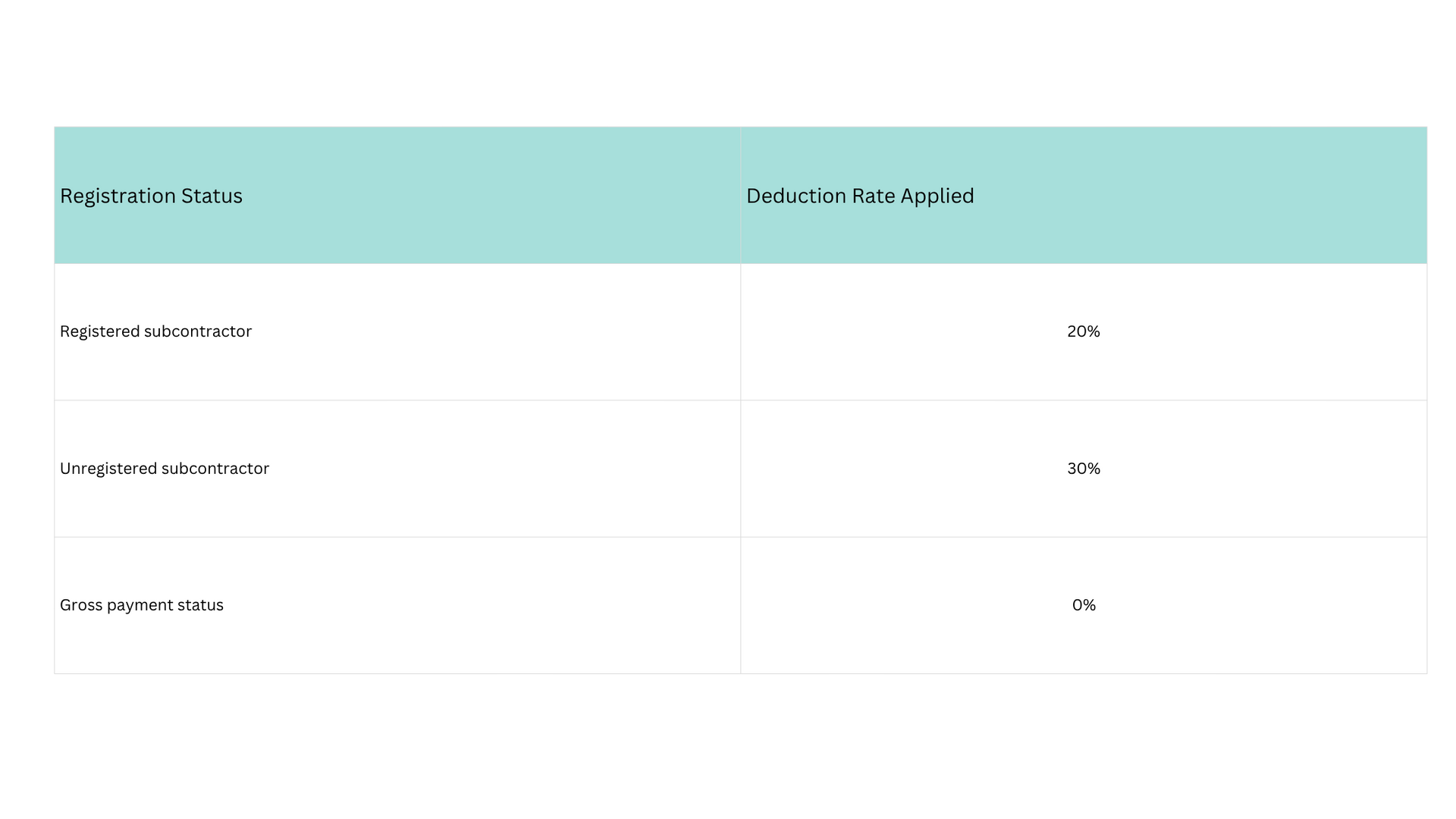
An unregistered subcontractor loses 30p in every pound to HMRC upfront, significantly more than the standard 20%. While this can be reclaimed, it creates a real cash flow problem throughout the year.
Gross Payment Status: The Gold Standard
Gross payment status (GPS) means a subcontractor receives their full payment with no deductions made. They then manage their own tax liability directly with HMRC.
To qualify, subcontractors must meet three tests:
- Business test - you must be carrying out construction work in the UK through a business
- Turnover test - annual turnover from construction (excluding materials) must be at least £30,000 for sole traders, or £30,000 per partner/director for partnerships and limited companies
- Compliance test - you must have a clean record with HMRC: tax returns filed on time, payments up to date, no history of serious non-compliance
HMRC reviews GPS holders annually, and it can be withdrawn if compliance slips. If that happens, deductions resume immediately, which is why keeping your tax affairs in order is essential, not optional.
How CIS Deductions Work
When a contractor pays a subcontractor, the deduction applies to the labour element of the payment only, not materials. This is an important distinction.
For example:
- A subcontractor invoices £3,000: £2,000 labour + £1,000 materials
- CIS deduction applies to the £2,000 labour only
- At 20%: £400 is deducted and paid to HMRC
- The subcontractor receives £2,600
The contractor must provide the subcontractor with a deduction statement for every payment, showing the gross amount, any materials costs, the deduction made, and the net amount paid. These statements are important; subcontractors need them to reclaim overpaid tax.
Monthly Contractor Returns
Every month, contractors must submit a CIS return to HMRC, even if no subcontractors were paid that month (you can notify HMRC it’s a nil return). The return must include:
- Details of every subcontractor paid that month
- The gross amount, materials costs, and deductions made for each
- Confirmation that the employment status of each subcontractor has been verified
Deadline: The 19th of the month following the payment month. Late filing carries automatic penalties starting at £100, rising the longer the return is outstanding.
Verifying Subcontractors
Before making the first payment to any subcontractor, contractors must verify them with HMRC. This process confirms whether the subcontractor is registered and what deduction rate applies.
Verification can be done online through HMRC’s CIS service or via your accounting software. HMRC will provide a verification number; keep this on record.
You only need to verify a subcontractor once per tax year (unless they leave and return). If you pay the same subcontractors regularly, keep a log so you’re not reverifying unnecessarily.
Reclaiming CIS Deductions as a Subcontractor
If you’re a subcontractor with deductions made against your payments, you can reclaim them. How you do this depends on your business structure:
- Sole traders and partnerships: Deductions are offset against your Self Assessment tax bill. If deductions exceed your liability, HMRC will refund the difference.
- Limited companies: Deductions are offset against PAYE and employer NI liabilities. If there’s still a surplus, you can apply to HMRC for a direct refund.
Either way, you need your deduction statements to make the claim. Missing or inaccurate statements cause delays, another reason accurate record-keeping matters so much.
Common CIS Mistakes (and How to Avoid Them)
Even experienced construction businesses trip up on CIS. The most common issues include:
Forgetting to verify before paying - deducting at the wrong rate or missing the verification step entirely. Always verify first, every time.
Deducting from materials - CIS applies to labour only. Deducting from the full invoice amount means subcontractors are overtaxed, and the contractor’s return will be wrong.
Missing the monthly return deadline - penalties are automatic and don’t require a formal investigation. Set a recurring reminder for the 19th of each month.
Not keeping deduction statements - subcontractors need these to reclaim tax. Issuing them promptly is a legal requirement.
Misclassifying workers - the line between employed and self-employed can be blurry in construction. Getting it wrong has serious consequences, including potential back-payment of PAYE, NI, and penalties. If you’re unsure, take advice before assuming someone is a subcontractor.
How Bluebells Bookkeeping Can Help
CIS compliance involves monthly deadlines, careful record-keeping, and detailed calculations. For a busy construction business, it’s exactly the kind of task that benefits from specialist support.
We can help you to:
- Set up and manage your CIS registrations
- Handle monthly contractor returns on your behalf
- Keep deduction statements accurate and issued on time
- Reconcile CIS deductions to ensure your records match HMRC’s
- Support subcontractors in reclaiming deductions efficiently
- Flag compliance risks before they become penalties
Getting CIS right isn’t just about avoiding fines. It’s about running a business where your finances are in order, your subcontractors trust you, and your relationship with HMRC stays clean.
Need help managing your CIS obligations?
The team at Bluebells Bookkeeping works with construction businesses to take the stress out of CIS compliance, from monthly returns to subcontractor verification and everything in between. Get in touch to find out how we can help.